
Short forms rule modern texting. Every year, new slang appears while old abbreviations gain fresh meanings. One such term people constantly search for is “TS.” You see it in chats, comments, captions, and DMs, yet its meaning often feels unclear.
People search what does TS mean in text in 2026 because context changes everything. One message can feel serious, another emotional, and another playful. This guide breaks down every meaning, use case, and cultural angle so you always understand what someone truly means.
You will learn definitions, real examples, emotional intent, variations, and how to respond naturally.
Definition & Core Meaning of TS in Text
TS is a multi-meaning abbreviation. Its definition depends fully on context, tone, and platform.
Most Common Meanings of TS
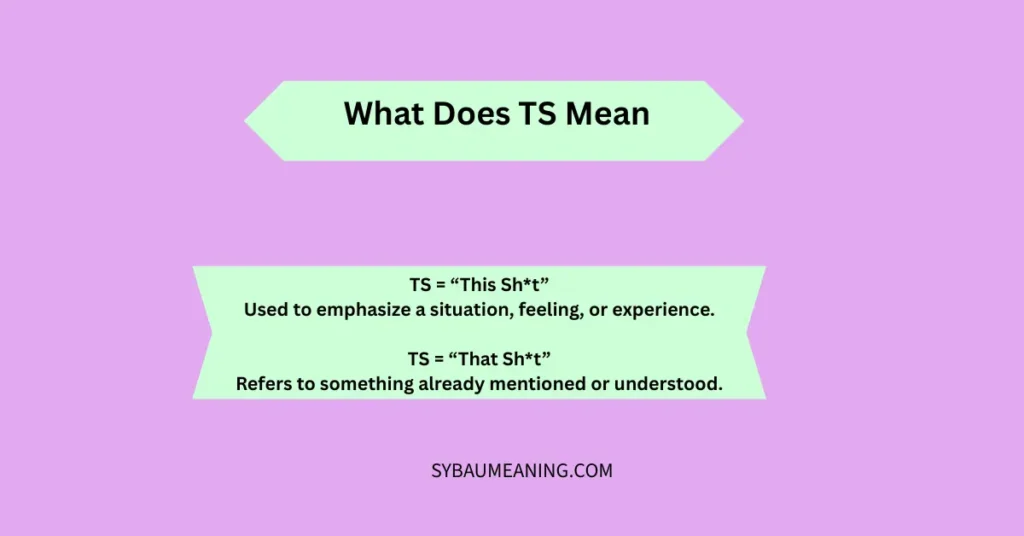
- TS = “This Sh*t”
Used to emphasize a situation, feeling, or experience. - TS = “That Sh*t”
Refers to something already mentioned or understood. - TS = “Tough Sh*t”
Expresses dismissal, sarcasm, or emotional distance. - TS = “True Story”
Confirms honesty or authenticity. - TS = “Text Soon”
A casual sign-off in conversations.
Simple Text Examples
- “I can’t deal with ts anymore.”
- “You know ts already happened.”
- “That was wild, ts.”
- “Gotta go now, ts.”
Each meaning shifts with emotion, relationship, and situation.
Historical & Cultural Background of TS
Early Language Roots
Abbreviations existed long before smartphones. Ancient scribes shortened words to save space on stone, paper, and parchment. Humans always looked for faster communication.
Rise in Digital Culture
TS gained popularity with:
- SMS character limits
- Early chat rooms
- Hip-hop lyrics
- Online gaming communities
Short forms became identity markers rather than just time savers.
Cultural Interpretations
- Western cultures: TS often feels casual, emotional, or expressive.
- Asian digital spaces: TS appears less frequently but often mimics Western slang.
- Indigenous storytelling parallels: Short symbolic expressions represented complex ideas, similar to modern abbreviations.
TS reflects how language compresses meaning without losing emotion.
Emotional & Psychological Meaning of TS
Words carry emotional weight, even when shortened.
Emotional Signals Behind TS
- Frustration: “I’m tired of ts.”
- Acceptance: “It is what it is, ts.”
- Confidence: “I handled ts.”
- Dismissal: “TS, move on.”
Psychological Impact
Using TS helps people:
- Release stress quickly
- Avoid over-explaining
- Protect emotional boundaries
- Signal shared understanding
It often acts as emotional shorthand between people who trust each other.
Different Contexts & Use Cases
Personal Life
Friends use TS to vent or joke.
- “I’m done explaining ts.”
- “You remember ts from last year?”
It feels informal and emotionally open.
Social Media
TS appears in:
- Tweets
- TikTok captions
- Instagram comments
Example:
- “Survived ts somehow.”
It adds relatability and authenticity.
Relationships
Partners use TS to express feelings quickly.
- “We’ve been through ts together.”
- “TS hurt, not gonna lie.”
Tone matters deeply here.
Professional or Modern Usage
In professional settings, TS can mean:
- Technical Support
- Task Status
- Time Series
Context decides everything.
See also: What Does FR Mean in Text?
Hidden, Sensitive, or Misunderstood Meanings
What People Often Get Wrong
- Assuming TS always means profanity
- Ignoring tone and timing
- Missing cultural context
When Meaning Changes
- Angry tone: dismissive or harsh
- Playful tone: humorous or sarcastic
- Supportive tone: shared struggle
TS can feel rude or relatable depending on delivery.
Cultural Sensitivity
Some audiences find TS offensive due to implied language. Use it carefully in mixed or professional groups.
Comparison Table: TS vs Similar Slang
| Term | Meaning | Emotional Tone | Usage Level |
|---|---|---|---|
| TS | This/That Sh*t | Flexible | Very Common |
| TBH | To Be Honest | Reflective | Common |
| IDK | I Don’t Know | Neutral | Universal |
| SMH | Shaking My Head | Disapproval | Common |
| IMO | In My Opinion | Polite | Semi-formal |
Key Insight: TS carries more emotional weight than most abbreviations.
Popular Types & Variations of TS (2026)
- TS (This Sh*t) – Emotional emphasis
- TS (That Sh*t) – Refers back to context
- TS (True Story) – Confirms honesty
- TS (Tough Sh*t) – Dismissive response
- TSK (TS + K) – Emphasized frustration
- TS fr – TS for real
- TS rn – Current emotional state
- TS vibes – Emotional atmosphere
- TS energy – Attitude or mood
- Lowkey TS – Subtle frustration
Each variation adds nuance without extra words.
How to Respond When Someone Uses TS
Casual Responses
- “Yeah, I get ts.”
- “Same ts here.”
Meaningful Responses
- “That ts sounds heavy.”
- “You’re not alone in ts.”
Fun Responses
- “TS really chose chaos.”
- “TS wild today.”
Private or Sensitive Responses
- “Want to talk about ts?”
- “I’m here if ts feels too much.”
Matching tone builds trust.
Regional & Cultural Differences
Western Usage
- Common in US, UK, Canada
- Casual and expressive
- Often emotional
Asian Digital Culture
- Less frequent
- Used mainly in English-based platforms
- Often mirrors Western meaning
Middle Eastern Context
- Used in bilingual chats
- Often softened to avoid offense
African & Latin Cultures
- Popular among youth
- Integrated with local slang
- Strong emotional expression
TS adapts to culture without losing core meaning.
Frequently Asked Questions
What does TS mean in texting in 2026?
It usually means “this sht” or “that sht,” depending on context.
Is TS rude or offensive?
It can be if used harshly or with strangers.
Does TS always mean something negative?
No. It can express pride, humor, or shared struggle.
Can TS be used professionally?
Only when it stands for technical terms, not slang.
What does TS mean on social media?
It highlights emotion, authenticity, or mood.
Is TS still popular in 2026?
Yes. It remains common due to emotional flexibility.
Conclusion
TS survives because it feels real. It compresses emotion, experience, and tone into two letters. In 2026, people value speed and authenticity, and TS delivers both.
Understanding TS means understanding people. Pay attention to context, emotion, and culture. When you do, every message becomes clearer and more human.


